Teaching Utopian and Dystopian Narratives in High School English

Introduction
Stories about the future have fascinated readers for centuries. From ideal societies that promise equality and peace to dystopian worlds marked by surveillance, inequality, and environmental collapse, speculative fiction encourages students to ask one essential question: What kind of future do we want?
Die im Text erwähnten Unterrichtsmaterialien auf einen Blick. Digitaler Download, sofort einsetzbar.
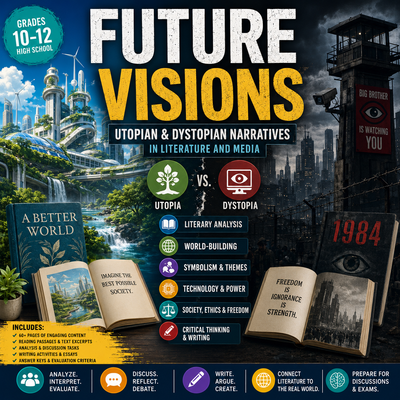

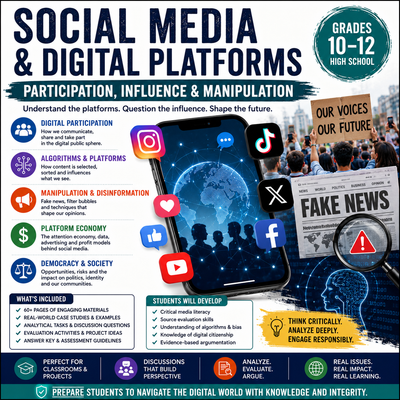
Teaching utopian and dystopian narratives gives English teachers an outstanding opportunity to combine literary analysis with meaningful discussions about technology, artificial intelligence, democracy, climate change, ethics, identity, and social responsibility.
Why Teach Utopian and Dystopian Literature?
Future-oriented literature encourages students to move beyond simple plot analysis. Instead, they evaluate how authors use fictional societies to comment on contemporary issues and challenge readers to reflect on their own world.
- develop critical thinking
- strengthen literary analysis
- encourage ethical reasoning
- connect literature with current events
- promote media literacy
- prepare students for discussion-based learning
Understanding Utopias and Dystopias
Utopias describe imagined societies that appear highly desirable, often emphasizing harmony, equality, innovation, or peace. Dystopias, by contrast, present fictional societies where oppression, inequality, surveillance, environmental destruction, or technological control expose weaknesses within contemporary society. Rather than predicting the future, these narratives encourage readers to question the present. :contentReference[oaicite:1]{index=1}
Key Themes for Classroom Discussion
Technology and Artificial Intelligence
Students investigate how emerging technologies can improve society while also creating ethical dilemmas surrounding privacy, automation, and surveillance.
Power and Government
Many dystopian texts explore authoritarian governments, censorship, propaganda, and individual freedom, making them excellent starting points for civic discussions.
Climate Change and Sustainability
Environmental collapse and ecological futures frequently appear in contemporary speculative fiction, encouraging interdisciplinary connections with science and geography.
Identity and Human Rights
Students analyze how fictional societies shape identity, diversity, equality, and individual rights while comparing literary worlds with modern democratic values.
Engaging Classroom Activities
Activity 1: Build a Utopia
Student groups design their own ideal society, establishing laws, education systems, economies, environmental policies, and technological innovations before evaluating potential weaknesses.
Activity 2: Dystopian News Report
Students produce fictional television news broadcasts from inside a dystopian society, encouraging perspective-taking and creative writing.
Activity 3: Future Ethics Debate
- Should artificial intelligence govern societies?
- Can surveillance increase public safety?
- Should technology limit individual freedom?
- What responsibilities do citizens have?
Activity 4: Compare Literature and Reality
Students compare fictional societies with current global developments, evaluating which literary warnings remain relevant today.
Suggested Unit Structure
Lesson 1
- Introduction to utopias and dystopias
- Historical development
- Genre characteristics
Lesson 2
- Power
- Control
- Surveillance
Lesson 3
- Technology
- Artificial intelligence
- Ethics
Lesson 4
- Climate futures
- Social transformation
- Global challenges
Lesson 5
- Creative future scenarios
- Debates
- Student presentations
Skills Students Develop
- literary analysis
- critical thinking
- argumentative writing
- ethical reasoning
- creative problem solving
- communication skills
- media literacy
- interdisciplinary thinking
Differentiation Ideas
- literature circles
- creative writing
- podcast production
- multimedia presentations
- project-based learning
- comparative literary analysis
Common Student Challenges
Students sometimes assume dystopian fiction is simply about dark futures. Effective teaching highlights that these narratives function primarily as social criticism, encouraging readers to question present-day developments rather than predict inevitable outcomes. Research also suggests that discussion-based and student-centered approaches make dystopian literature especially effective for developing intercultural awareness and critical literacy. :contentReference[oaicite:2]{index=2}
Cross-Curricular Connections
- English Language Arts
- History
- Civics
- Philosophy
- Media Studies
- Environmental Studies
Recommended Classroom Resource
For a complete classroom-ready unit, explore:
Future Visions – Utopian & Dystopian Narratives
The unit includes structured reading activities, literary analysis tasks, discussion prompts, collaborative projects, creative writing assignments, assessments, and teacher guidance designed specifically for upper secondary English classrooms.
Related Classroom Resources
- Diversity in Society – Opportunities & Challenges
- Social Media & Digital Platforms – Media Literacy
- Classical & Multimodal Literary Formats
Frequently Asked Questions
Why teach dystopian literature?
Dystopian fiction encourages students to analyze society, question power structures, and develop critical literacy through meaningful classroom discussion. :contentReference[oaicite:3]{index=3}
What is the difference between utopian and dystopian literature?
Utopias imagine ideal societies, while dystopias present societies where current social, political, or technological problems are exaggerated to encourage reflection and critique. :contentReference[oaicite:4]{index=4}
What classroom skills does this topic develop?
Students strengthen literary interpretation, communication, ethical reasoning, creativity, media literacy, argumentative writing, and critical thinking.
How can teachers make future narratives engaging?
Creative world-building, debates, multimedia projects, comparisons with current events, and collaborative inquiry activities encourage high levels of student engagement.
Conclusion
Utopian and dystopian narratives encourage students to think critically about the relationship between literature and society. By exploring imagined futures, learners gain deeper insight into present-day challenges while developing the analytical, communicative, and ethical skills needed for active participation in an increasingly complex world.
Discover more engaging English teaching resources on stifo.de and inspire students to imagine—and critically evaluate—the future.
Das ganze Fach Englisch in einer Reihe
Einzelne Unterrichtsreihen decken ein Thema ab. Die FachKomplett-Reihe Englisch bündelt das Material für das gesamte Fach - einmal kaufen statt jedes Thema einzeln zusammenzusuchen.
 FachKomplett Englisch – 100+ Unterrichtsreihen einsatzbereit für den Englisch...
€99,90Zur Reihe
FachKomplett Englisch – 100+ Unterrichtsreihen einsatzbereit für den Englisch...
€99,90Zur Reihe
- Alle zentralen Themen des Fachs in einem Paket
- Arbeitsblätter mit Lösungen, Präsentationen und Verlaufsplänen
- Editierbare Formate, damit du an deine Lerngruppe anpassen kannst
- Deutlich günstiger als die enthaltenen Reihen einzeln
Luca beschäftigt sich seit Jahren intensiv mit der Frage, was guten Unterricht ausmacht - und wie Lehrkräfte dabei wirklich entlastet werden können. Als Gründer von stifo.de entwickelt er strukturierte Unterrichtsmaterialien, die Lehrerinnen und Lehrer im Alltag spürbar unterstützen: durchdacht aufgebaut, direkt einsetzbar und didaktisch solide.
Das könnte dich auch interessieren

FAQ zu den Unterrichtsmaterialien
Das Sortiment reicht von der Kita über die Grundschule und die Sekundarstufe I (Klasse 5–10) bis zur Sekundarstufe II und zur Berufsschule. Jedes Material ist nach Fach, Stufe und - wo sinnvoll - nach Bundesland beschriftet.
Viele Reihen lassen sich mit kleinen Anpassungen auch in benachbarten Schulformen einsetzen, weil die Aufgaben in mehreren Anforderungsniveaus vorliegen.
Eine vollständige Reihe enthält in der Regel:
- mehrere Arbeitsblätter mit ausgearbeiteten Lösungen
- eine Präsentation für den Unterrichtseinstieg
- einen Verlaufsplan für die Stundenstruktur
- Aufgaben auf mehreren Anforderungsniveaus zur Differenzierung
- je nach Reihe Klausur- oder Testvorlagen
Die Dateien liegen in editierbaren Formaten vor, damit du Inhalte an deine Lerngruppe anpassen kannst.
Direkt nach dem Kauf erhältst du eine Bestätigungs-E-Mail mit dem Download-Link. Zusätzlich liegen die Dateien dauerhaft in deinem Kundenkonto unter „Bestellungen" - ohne Ablaufdatum und ohne Downloadlimit.
Es gibt keinen Versand und keine Wartezeit: Der Download steht unmittelbar nach dem Abschluss der Bestellung bereit.
Die Einzellizenz gilt für eine Lehrkraft. Du darfst das Material ausdrucken und im eigenen Unterricht beliebig oft einsetzen. Die digitalen Dateien an andere Lehrkräfte weiterzugeben oder sie zu veröffentlichen, ist davon nicht gedeckt.
Für Fachschaften gibt es bei vielen Produkten eine Schullizenz, die mehrere Lehrkräfte einer Schule abdeckt. Sie steht direkt auf der Produktseite zur Auswahl.
Eine Unterrichtsreihe deckt ein einzelnes Thema ab, etwa „Genetik" oder „Kurzgeschichten analysieren". Sie passt, wenn du gezielt eine Sequenz vorbereitest.
Ein FachKomplett-Paket bündelt die zentralen Themen eines ganzen Fachs zu einem Gesamtpreis, der deutlich unter der Summe der Einzelreihen liegt. Das lohnt sich, sobald du ein Fach dauerhaft unterrichtest. Für Englisch findest du die Reihe hier.
Die Materialien orientieren sich an den veröffentlichten Vorgaben der Länder - je nach Bundesland am Kernlehrplan, Kerncurriculum, Bildungsplan, Rahmenlehrplan oder an den Fachanforderungen. Für viele Fächer gibt es eigene Pakete je Bundesland.
Eine Prüfung, Zulassung oder Empfehlung durch ein Ministerium besteht nicht. Da die Vorgaben zwischen den Ländern abweichen, lohnt sich vor dem Einsatz ein kurzer Abgleich mit dem schulinternen Lehrplan.
Kommentare
Kommentar hinterlassen
Kommentare werden vor der Veröffentlichung geprüft.
Unterrichtstipps per E-Mail
Neue Materialien, Planungshilfen und Hinweise zu Lehrplanänderungen - etwa zweimal im Monat, ohne Werbeflut.