English Abitur Topics Explained – Media Literacy, Diversity and Future Visions for Students

Introduction
In upper secondary English, many topics are connected: social media, media literacy, diversity, multimodal literature, utopian and dystopian narratives, artificial intelligence and future society. At first, these topics may seem very different. However, they all ask similar questions: How do we communicate? How do we live together? How do media shape our opinions? What kind of future do we want?
Die im Text erwähnten Unterrichtsmaterialien auf einen Blick. Digitaler Download, sofort einsetzbar.
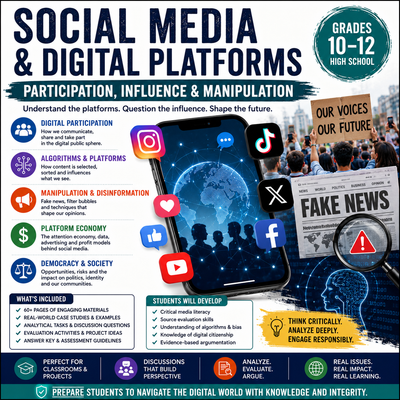

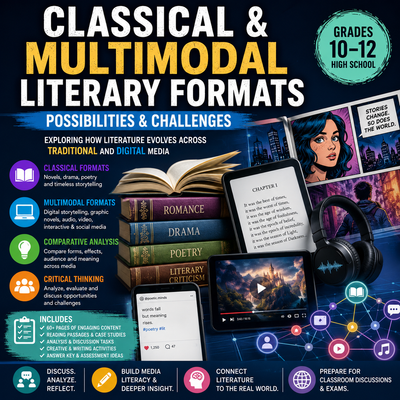
This guide is written for students. It explains the most important questions in clear language and helps you prepare for class discussions, presentations, essays and exams.
Why are these topics important in English class?
English is not only about grammar and vocabulary. In upper secondary school, English helps you understand global issues, analyze authentic texts and discuss complex ideas. Topics such as media literacy, diversity and future visions train skills that you need in exams and in real life.
- understanding different perspectives
- analyzing texts, images and videos
- evaluating information critically
- forming your own opinion
- writing balanced arguments
- discussing global issues in English
Question 1: What is media literacy?
Media literacy means the ability to understand, analyze and evaluate media. This includes news articles, social media posts, videos, advertisements, podcasts, images and AI-generated content.
In simple terms: Media literacy helps you ask whether information is reliable, who created it, why it was created and how it tries to influence you.
Useful exam phrases
- The source appears reliable because...
- The author tries to persuade the audience by...
- The post may be misleading because...
- The message is shaped by language, images and emotional appeal.
Question 2: How do social media platforms influence us?
Social media platforms do not show everyone the same content. Algorithms decide what appears in your feed. They often recommend content based on what you liked, watched, shared or clicked before.
This can be helpful, but it can also create filter bubbles. A filter bubble means that you mainly see content that confirms your existing opinions.
Important terms
- Algorithm: a system that selects and recommends content
- Filter bubble: a personalized information environment
- Misinformation: false information that may be shared unintentionally
- Disinformation: false information shared deliberately
- Digital footprint: the data you leave behind online
To practise this topic, you can use the unit Social Media & Digital Platforms – Media Literacy.
Question 3: Why is diversity important in society?
Diversity means that people differ in culture, language, background, identity, beliefs, experiences and perspectives. A diverse society can be creative, dynamic and open-minded, but it also needs respect, inclusion and equal opportunities.
In English class, diversity is often discussed through speeches, articles, literature, films or personal stories. The goal is not to memorize one perfect opinion. The goal is to understand different perspectives and argue respectfully.
Useful arguments
- Diversity can strengthen empathy and intercultural understanding.
- Different perspectives can lead to better problem-solving.
- Inclusion means that people are not only present but also valued.
- Challenges may include stereotypes, discrimination or unequal opportunities.
For more practice, see Diversity in Society – Opportunities, Challenges & Social Transformation.
Question 4: What are classical and multimodal literary formats?
Classical literary formats include novels, short stories, poems, plays and speeches. Multimodal formats combine different forms of communication, such as text, image, sound, movement or digital interaction.
Examples of multimodal texts include graphic novels, films, podcasts, digital stories, websites, videos and interactive narratives.
How to analyze multimodal texts
- What is the main message?
- How do words, images and sound work together?
- How does the format influence the audience?
- What is different from a traditional written text?
- Which perspective is presented?
A helpful resource for this topic is Classical & Multimodal Literary Formats.
Question 5: What is the difference between utopia and dystopia?
A utopia is an imagined ideal society. It often presents a world with peace, justice, equality or technological progress. A dystopia is the opposite: it shows a negative future with control, inequality, surveillance, environmental destruction or loss of freedom.
However, dystopian stories are not only about the future. They usually criticize problems that already exist in the present.
Typical dystopian themes
- surveillance
- censorship
- loss of individuality
- abuse of power
- social inequality
- environmental collapse
- technology without ethical limits
To prepare this topic, use Future Visions – Utopian & Dystopian Narratives.
Question 6: How are future society and media literacy connected?
Future society is strongly shaped by technology, artificial intelligence, social media, climate change and global cooperation. Media literacy helps you understand these changes instead of simply accepting them.
For example, if artificial intelligence creates texts, images or videos, students need to ask: Who created this? Is it reliable? Is it fair? Could it be biased? What impact does it have on society?
Key questions for discussion
- How will artificial intelligence change education and work?
- Can technology make society fairer?
- How can people protect their privacy online?
- Who is responsible for misinformation?
- What skills will students need in the future?
The bundle Future Society & Media Literacy XXL Bundle connects these topics in one larger learning unit.
How to write a strong essay on these topics
Many exam tasks ask you to comment on a statement, discuss advantages and disadvantages or analyze a text. A strong essay is balanced, clear and well structured.
Basic essay structure
- Introduction: introduce the topic and the main question
- Main part: present arguments, examples and counterarguments
- Conclusion: summarize your view and answer the question
Useful phrases
- One important aspect is...
- Another argument in favor of this view is...
- However, it should also be considered that...
- This example shows that...
- From my point of view...
- Overall, it can be argued that...
How to prepare for class discussions
For discussions, you do not need to know every possible fact. You need clear ideas, useful vocabulary and the ability to react to other opinions.
- prepare three arguments before the lesson
- learn key terms for the topic
- use examples from texts, media or real life
- listen carefully to other students
- agree or disagree politely
- support your opinion with reasons
Most important vocabulary
- media literacy
- digital citizenship
- misinformation
- algorithm
- filter bubble
- diversity
- inclusion
- identity
- utopia
- dystopia
- surveillance
- artificial intelligence
- global citizenship
- critical thinking
- social transformation
Related learning resources
- Social Media & Digital Platforms – Media Literacy
- Diversity in Society – Opportunities, Challenges & Social Transformation
- Classical & Multimodal Literary Formats
- Future Visions – Utopian & Dystopian Narratives
- Future Society & Media Literacy XXL Bundle
Frequently Asked Questions
What are the most important English topics for upper secondary students?
Important topics include media literacy, diversity, digital platforms, artificial intelligence, future society, multimodal literature and utopian or dystopian narratives.
How can I prepare for an English exam on media literacy?
Learn key terms such as algorithm, misinformation, filter bubble and digital footprint. Practise analyzing how language, images and platform structures influence the audience.
How do I write about diversity in English?
Use balanced arguments. Mention opportunities such as empathy, creativity and intercultural understanding, but also challenges such as stereotypes, discrimination and unequal access.
Why are dystopian texts useful in English class?
They help students discuss power, technology, freedom, surveillance, inequality and the future while developing literary analysis and critical thinking skills.
What is the best way to improve my English for these topics?
Read short articles, learn topic vocabulary, practise writing introductions and conclusions, and prepare arguments before discussions.
Conclusion
Media literacy, diversity, multimodal literature and future visions are not just school topics. They help you understand the world around you. If you learn the key terms, practise balanced arguments and connect texts with real-life examples, you will be well prepared for English lessons, exams and discussions.
Explore the linked learning resources on stifo.de to practise these topics step by step and build confidence for upper secondary English.
Das ganze Fach Englisch in einer Reihe
Einzelne Unterrichtsreihen decken ein Thema ab. Die FachKomplett-Reihe Englisch bündelt das Material für das gesamte Fach in der Sek II - einmal kaufen statt jedes Thema einzeln zusammenzusuchen.
 FachKomplett Englisch – 100+ Unterrichtsreihen einsatzbereit für den Englisch...
€99,90Zur Reihe
FachKomplett Englisch – 100+ Unterrichtsreihen einsatzbereit für den Englisch...
€99,90Zur Reihe
- Alle zentralen Themen des Fachs in einem Paket
- Arbeitsblätter mit Lösungen, Präsentationen und Verlaufsplänen
- Editierbare Formate, damit du an deine Lerngruppe anpassen kannst
- Deutlich günstiger als die enthaltenen Reihen einzeln
Luca beschäftigt sich seit Jahren intensiv mit der Frage, was guten Unterricht ausmacht - und wie Lehrkräfte dabei wirklich entlastet werden können. Als Gründer von stifo.de entwickelt er strukturierte Unterrichtsmaterialien, die Lehrerinnen und Lehrer im Alltag spürbar unterstützen: durchdacht aufgebaut, direkt einsetzbar und didaktisch solide.
Das könnte dich auch interessieren

FAQ zu den Unterrichtsmaterialien
Das Sortiment reicht von der Kita über die Grundschule und die Sekundarstufe I (Klasse 5–10) bis zur Sekundarstufe II und zur Berufsschule. Jedes Material ist nach Fach, Stufe und - wo sinnvoll - nach Bundesland beschriftet.
Viele Reihen lassen sich mit kleinen Anpassungen auch in benachbarten Schulformen einsetzen, weil die Aufgaben in mehreren Anforderungsniveaus vorliegen.
Eine vollständige Reihe enthält in der Regel:
- mehrere Arbeitsblätter mit ausgearbeiteten Lösungen
- eine Präsentation für den Unterrichtseinstieg
- einen Verlaufsplan für die Stundenstruktur
- Aufgaben auf mehreren Anforderungsniveaus zur Differenzierung
- je nach Reihe Klausur- oder Testvorlagen
Die Dateien liegen in editierbaren Formaten vor, damit du Inhalte an deine Lerngruppe anpassen kannst.
Direkt nach dem Kauf erhältst du eine Bestätigungs-E-Mail mit dem Download-Link. Zusätzlich liegen die Dateien dauerhaft in deinem Kundenkonto unter „Bestellungen" - ohne Ablaufdatum und ohne Downloadlimit.
Es gibt keinen Versand und keine Wartezeit: Der Download steht unmittelbar nach dem Abschluss der Bestellung bereit.
Die Einzellizenz gilt für eine Lehrkraft. Du darfst das Material ausdrucken und im eigenen Unterricht beliebig oft einsetzen. Die digitalen Dateien an andere Lehrkräfte weiterzugeben oder sie zu veröffentlichen, ist davon nicht gedeckt.
Für Fachschaften gibt es bei vielen Produkten eine Schullizenz, die mehrere Lehrkräfte einer Schule abdeckt. Sie steht direkt auf der Produktseite zur Auswahl.
Eine Unterrichtsreihe deckt ein einzelnes Thema ab, etwa „Genetik" oder „Kurzgeschichten analysieren". Sie passt, wenn du gezielt eine Sequenz vorbereitest.
Ein FachKomplett-Paket bündelt die zentralen Themen eines ganzen Fachs zu einem Gesamtpreis, der deutlich unter der Summe der Einzelreihen liegt. Das lohnt sich, sobald du ein Fach dauerhaft unterrichtest. Für Englisch findest du die Reihe hier.
Die Materialien orientieren sich an den veröffentlichten Vorgaben der Länder - je nach Bundesland am Kernlehrplan, Kerncurriculum, Bildungsplan, Rahmenlehrplan oder an den Fachanforderungen. Für viele Fächer gibt es eigene Pakete je Bundesland.
Eine Prüfung, Zulassung oder Empfehlung durch ein Ministerium besteht nicht. Da die Vorgaben zwischen den Ländern abweichen, lohnt sich vor dem Einsatz ein kurzer Abgleich mit dem schulinternen Lehrplan.
Kommentare
Kommentar hinterlassen
Kommentare werden vor der Veröffentlichung geprüft.
Unterrichtstipps per E-Mail
Neue Materialien, Planungshilfen und Hinweise zu Lehrplanänderungen - etwa zweimal im Monat, ohne Werbeflut.